Auray Town Hall Square and the Walk Down to the Port of Saint-Goustan
Most people pass Auray on the dual carriageway between Vannes and Lorient and keep driving. That's a mistake. The small Breton town has two centres stacked one above the other: an upper town built around Place de la République and its town hall, and the old river port of Saint-Goustan down in the valley. You can walk from one to the other in about ten minutes, and the walk is the best part.
Come to the square at blue hour, when the shops are still lit and the sky goes dark navy. The town hall takes up the far end of the cobbles, its pale stone washed in warm light, flags out on the first floor, the bell tower glowing on the roof. Black bollards keep cars to one side. On the right, a row of tall stone houses with shopfronts at street level. In the foreground, a blue sign marks the square as a shared zone with a 20 km/h limit, and a signpost points two ways: down to Saint-Goustan and the port, and out to Vannes.
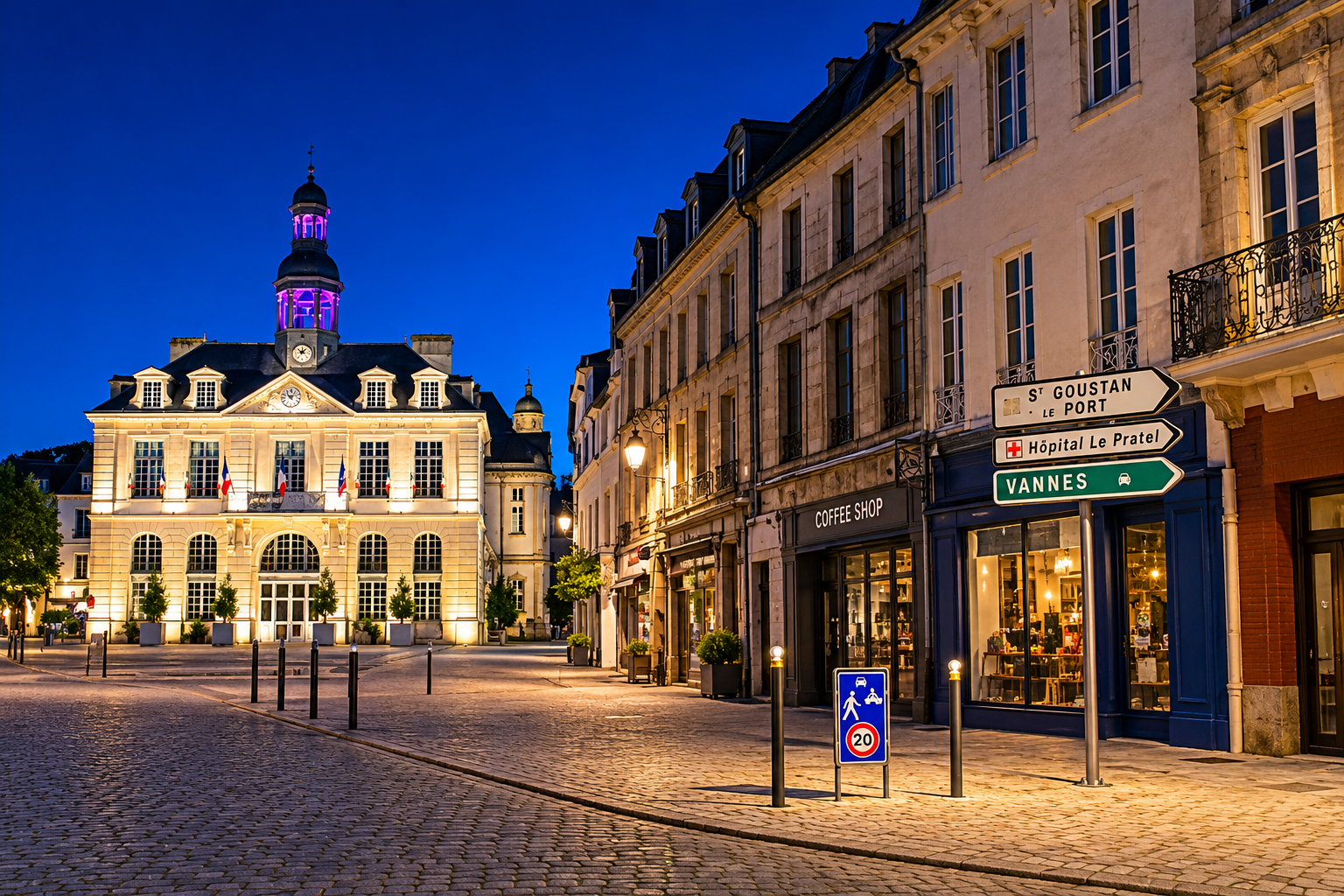
Photograph hosted by TravelMktg.com.
A Town Hall Built for a Market Square
The Hôtel de Ville went up between 1776 and 1782, designed by the engineer Jean Détaille de Kerroyant. It was built to lean against the old wooden market halls and the courtroom of the royal seneschal above them. Both are gone now, which is why the building looks so free-standing today. Auray had been the seat of a royal court since the sixteenth century, so this was a town that took its public buildings seriously.
The façade is light limestone and the belfry was modelled on the one on Rennes town hall. The building has been a listed historic monument since 1963. It is still the working town hall, with the council chamber and its paintings inside, so you see it from the square unless you catch one of the summer guided visits run by the town's heritage service.
Market Mornings
The square is quiet at night and busy in the morning. Auray's big weekly market fills the streets of the centre every Monday, from about 8:15 to 2pm (as of November 2026). On Friday mornings there's a smaller producers' market on Place Notre-Dame. Monday is the day to come if you want the town at full volume: vegetables, cheese, oysters from the nearby estuary, and a lot of people who know each other.
In December the square gets the town's Christmas lights, usually switched on in front of the town hall in the first week of the month.
Down to Saint-Goustan
Follow the sign. The streets drop steeply toward the river Loch, past half-timbered houses, until you come out at the stone bridge and the cobbled Place Saint-Sauveur. Flat shoes help. This is where Auray started, and in the sixteenth and seventeenth centuries the wine and grain trade made it the third port of Brittany.
The quay on the river side is named after Benjamin Franklin. He came ashore here in early December 1776, sent by the Continental Congress to ask Louis XVI for help in the War of Independence. So the town hall was being built up the hill while one of the founders of the United States was stepping off a boat at the bottom of it. Today the quay is cafés, crêperies and small boats, and it's the obvious place for a drink before you climb back up.
Getting There
Auray station is on the Paris to Quimper line. The fastest direct trains from Paris Montparnasse take a little under three hours, and Vannes is about ten minutes away by train. The station sits about 25 minutes on foot from the centre. In summer the Tire-Bouchon train runs from Auray down the Quiberon peninsula, on weekends in June and September and daily in July and August.
For more on both halves of the town, see Travel Marketing on Auray's town hall at blue hour and on the old port quarter of Saint-Goustan. Brittany castles nearby on this site: Château de Fougères.