Caesarea Maritima: Herod's Harbour City, the Ticket and the Free Aqueduct Beach
King Herod had no natural harbour on this stretch of coast, so he built one. Between about 22 and 10 BC his engineers sank huge blocks of hydraulic concrete into the open sea and made a port that could take the largest ships of the Roman world. Around it rose a city he named for his patron, Augustus Caesar: Caesarea.
It became the capital of the Roman province of Judaea, the seat of its governors, Pontius Pilate among them. Crusaders later walled part of it. Then the sand covered most of it, until 20th-century archaeologists dug it out. Today it's one of Israel's most visited national parks, on the coast between Tel Aviv and Haifa.
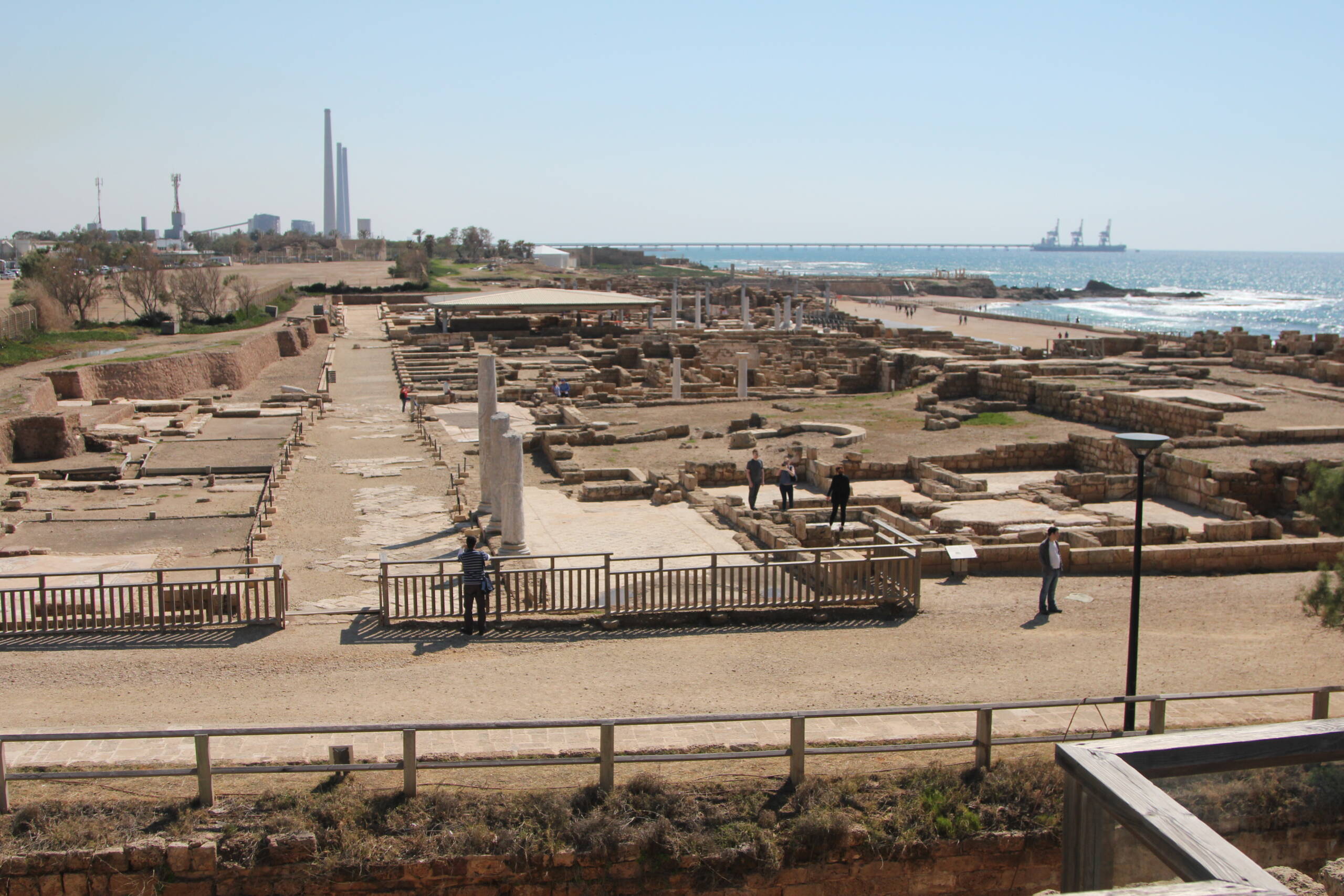
The photo below looks across the excavated city toward the sea: low walls of stone foundations laid out in a grid, a path running through the middle, people walking the edges, and the blue Mediterranean beyond. On the horizon, the striped chimneys of the Hadera power station remind you which century you're in.
What to see
The theatre. At the south end of the park, restored and still used for concerts, it held about 3,700 people. A stone found here in 1961 carries Pontius Pilate's name, one of the very few inscriptions from his own lifetime to mention him; the original is in the Israel Museum and a copy stands by the theatre.
Herod's palace. On a rock jutting into the sea, the ruins of the palace include the outline of a large pool cut into the rock with the sea on three sides.
The hippodrome. A long racetrack by the shore where some 10,000 spectators watched chariot races.
The harbour and Crusader town. At the north end, the walls and moat of the Crusader city enclose restaurants, a small museum and the old harbour, where you can still trace the line of Herod's breakwater under the water.
Tickets and hours
As of July 2026 adult entry costs 46 shekels and children and soldiers 27. The park opens 8:00 to 17:00 from April to September and 8:00 to 16:00 from October to March, closing an hour earlier on Fridays.
Check before you go. Israel's national parks closed during the spring 2026 war and reopened in phases from April, some with advance booking and visitor limits. The Israel Nature and Parks Authority posts each site's current status on its website.
The aqueduct beach
North of the park, outside the fence, a long stretch of Herod's high-level aqueduct runs right along the beach, its arches standing in the sand. It carried water to the city from springs at the foot of Mount Carmel to the north. Walk along it at sunset, when the stone turns orange and families spread out picnics under the arches.
Bring water and a hat for the park itself. There's little shade between the ruins, and in summer the sun off the sand is hard.
More on the site: Visit Caesarea Maritima and Marble and Myth: The Drinking Contest Sarcophagus at Caesarea on Travel Marketing.