Marienplatz in Munich: Glockenspiel Times, the Town Hall Tower and the Square After Oktoberfest
Marienplatz is where Munich meets. It's been the city's central square since the city was founded in 1158, its market place, its stage for tournaments and executions, and now its meeting point and transport hub, with S-Bahn and U-Bahn lines running underneath.
What dominates it today looks medieval and isn't. The New Town Hall, the Neues Rathaus, was built between 1867 and 1908 in a lavish neo-Gothic style, its long facade crowded with spires, statues, gargoyles and an 85-metre tower. The photo below, shot with a fisheye on an overcast day, curves the square into a bowl around it: the Rathaus and tower in the middle, people crossing in every direction, a woman wheeling a red suitcase, a cyclist pushing a bike.
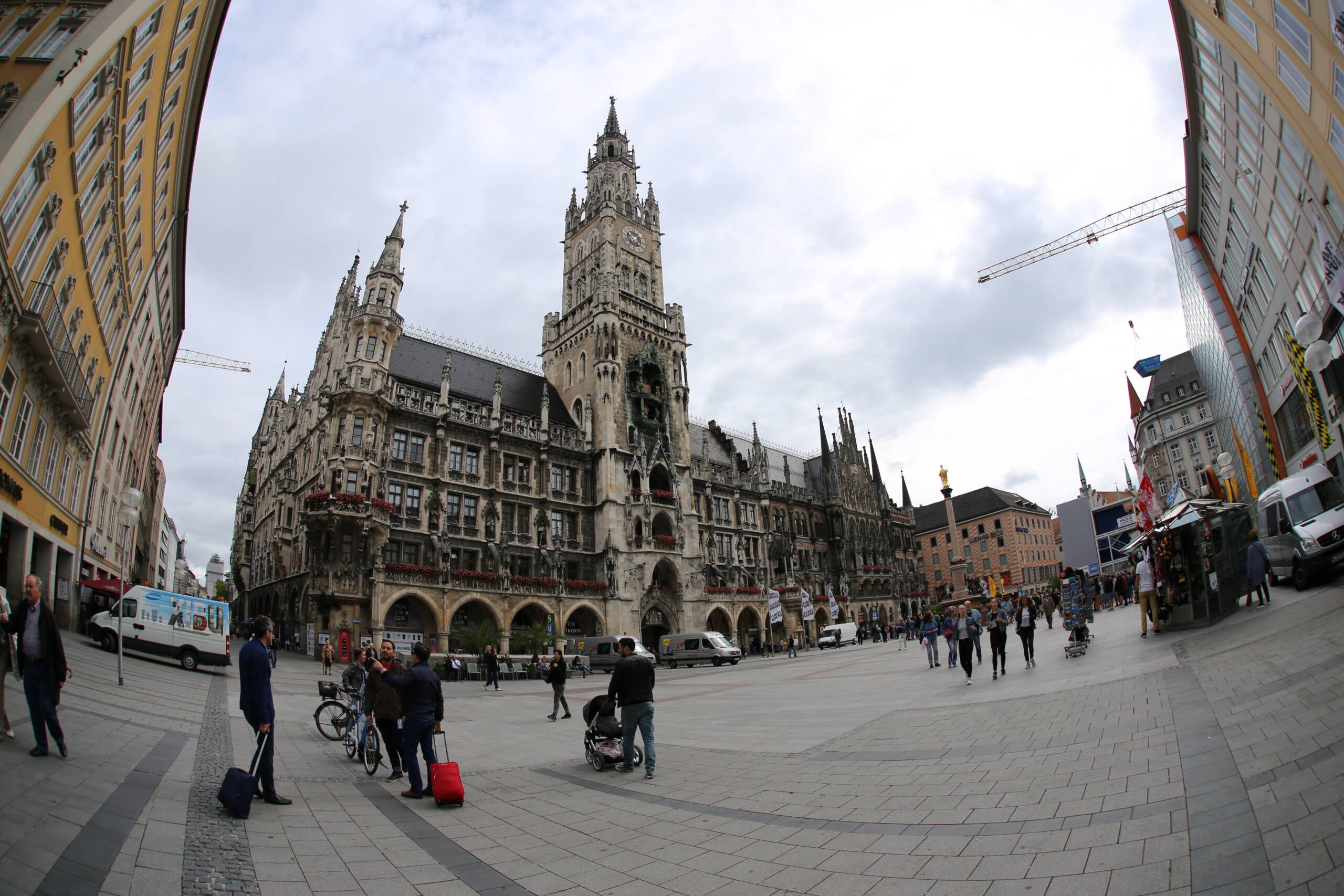
The Glockenspiel
The tower holds the Glockenspiel, one of the biggest in Europe, with 43 bells and 32 life-size figures. The show plays daily at 11:00 and 12:00, with an extra show at 17:00 from March to October. There's no show on Good Friday.
It tells two stories in two tiers. On top, the wedding of Duke Wilhelm V and Renata of Lorraine in 1568, complete with a jousting match in which a Bavarian knight unhorses the knight of Lorraine every time. Below, the coopers dance the Schäfflertanz, a dance said to have been first performed in 1517 to coax people back onto the streets after a plague. At the end a small golden cockerel at the top crows three times.
The whole thing runs 12 to 15 minutes. Stand well back from the facade, toward the far side of the square, to see both tiers at once.
Go up the tower
A lift runs up the Rathaus tower to a viewing platform near the top, with the twin onion domes of the Frauenkirche right next to you and, on clear days, the Alps on the southern horizon. Tickets start from €7, with reduced fares. The lift runs daily 10:00 to 20:00 in 20-minute slots, with a limit of 30 people on the platform, so expect a short wait.
After Oktoberfest
The 2026 Oktoberfest ran from 19 September to 4 October and set a record of about 7.4 million visitors. By the second week of October the city is back to itself. The crowds thin, hotel prices drop, and the square fills with locals again.
Marienplatz changes costume next in late November, when the Christkindlmarkt, Munich's main Christmas market, sets up its stalls in front of the Rathaus. That's the other busy season. Between the two, October and early November are the best time to see the square without either.
The Mariensäule, the column of the Virgin in the middle of the square, gives the square its name. It went up in 1638 to give thanks for the city's escape from destruction in the Thirty Years' War.
More on the square: Marienplatz, Munich: The Square That Runs the City on Travel Marketing.