The Met Cloisters in New York: Medieval Europe at the Top of Manhattan
At the northern tip of Manhattan, in a wooded park above the Hudson, there's a medieval monastery that was never a monastery. The Met Cloisters is the Metropolitan Museum's branch for the art and architecture of medieval Europe, and it's built partly out of the real thing: cloisters, chapels and doorways taken stone by stone from French and Spanish abbeys and set into a new building in the 1930s.
John D. Rockefeller Jr. paid for the land, the building and much of the collection, and gave the museum the park around it. He also bought the cliffs across the river in New Jersey so nobody could ever build on the view. The Cloisters opened in 1938. Walk through the gate today and Manhattan disappears.
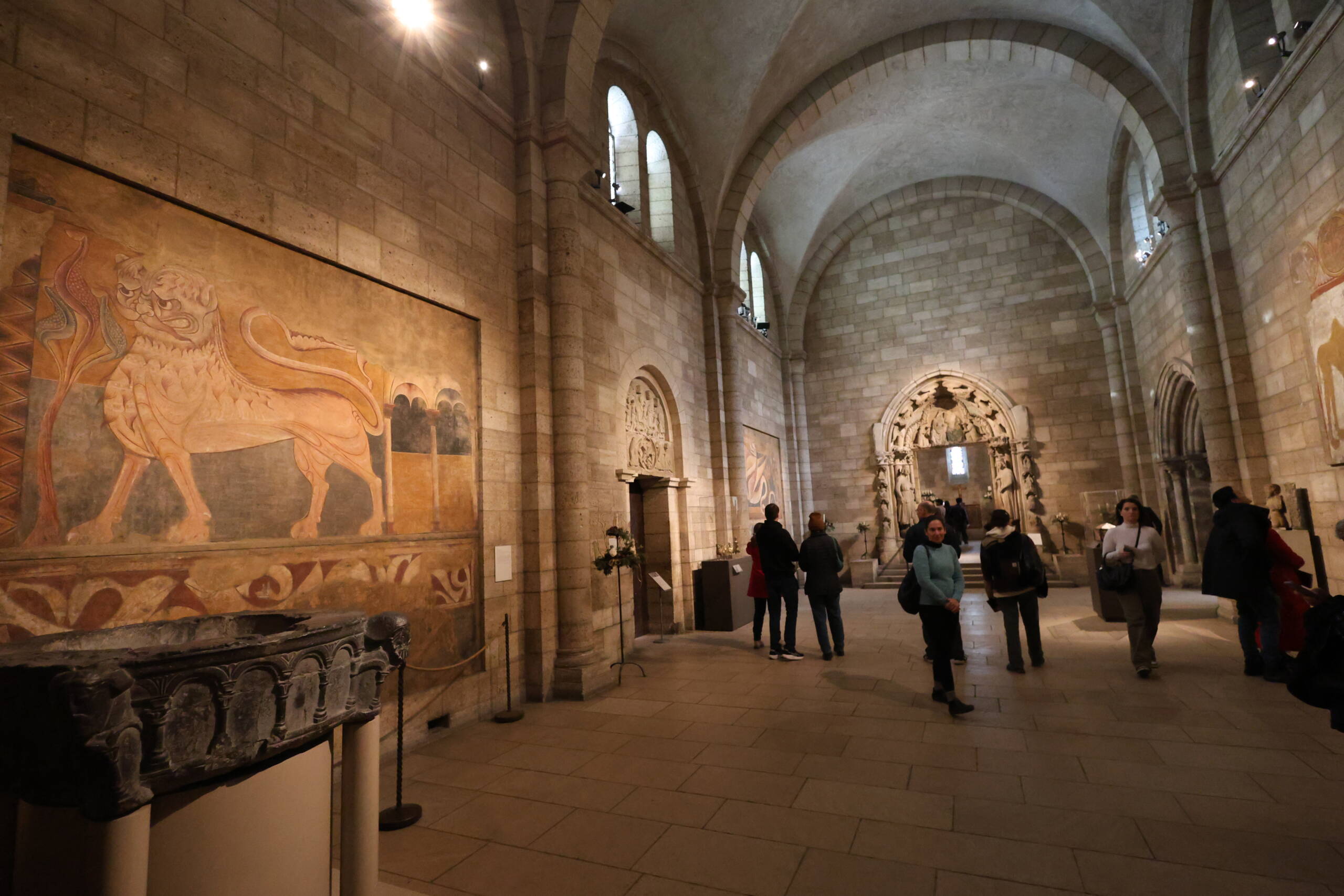
The photo below is one of the Romanesque rooms: pale stone walls, round-arched windows, a carved portal at the far end, and on the left wall a great faded lion from a medieval Spanish fresco. A winter crowd drifts through, coats on, voices low.
What to see
The cloisters themselves. Several cloister arcades from French monasteries are rebuilt around courtyards and gardens. The biggest, from the abbey of Saint-Michel-de-Cuxa in the Pyrenees, has a garden at its centre and pink marble columns with carved capitals. In summer the gardens are planted with herbs and flowers grown in the Middle Ages, labelled with what they were used for.
The Unicorn Tapestries. Seven tapestries woven around 1500 telling the hunt of the unicorn, in a room of their own. The last one, the unicorn alive and fenced in under a pomegranate tree, is the image on half the museum's postcards.
The Treasury. Small rooms of small objects: ivories, reliquaries, illuminated prayer books. Find the tiny boxwood prayer beads carved with whole scenes inside a nut-sized sphere, and bring your reading glasses.
The terrace. Behind the building, a terrace looks over the Hudson to the New Jersey Palisades. On a clear day it's one of the best views in New York, and one of the quietest.
Tickets and getting there
General admission is $30 for adults, $22 for seniors and $17 for students, and free for children 12 and under. One ticket also covers same-day entry to the Met on Fifth Avenue. New York State residents, and students from New York, New Jersey and Connecticut, pay what they wish, with proof.
The Cloisters is open Thursday to Tuesday, 10:00 to 17:00, and closed on Wednesdays, Thanksgiving, Christmas Day and New Year's Day. Plan around that Wednesday.
Take the A train to 190th Street and walk about ten minutes through Fort Tryon Park. Weekend track work on the A line can slow the trip; check before you go. Allow two hours inside and an hour in the park.
On the story of the place: A Medieval Dream in Manhattan: Who Built the Cloisters, When, and Why It Exists at All on Travel Marketing.