Jerónimos Monastery, Lisbon’s Extraordinary Manueline Portal
You could spend a good twenty minutes standing outside the church of Jerónimos Monastery in Lisbon and still discover something new above its doors. The south portal is one of those rare pieces of architecture that seems to reward looking at it from progressively closer distances. From across the square in Belém, it appears as a magnificent arrangement of towers, arches and pale stone. A few steps nearer, individual figures and elaborate patterns begin to emerge from the facade. Eventually, you find yourself looking at details that would scarcely be noticed on a hurried tour of Lisbon.
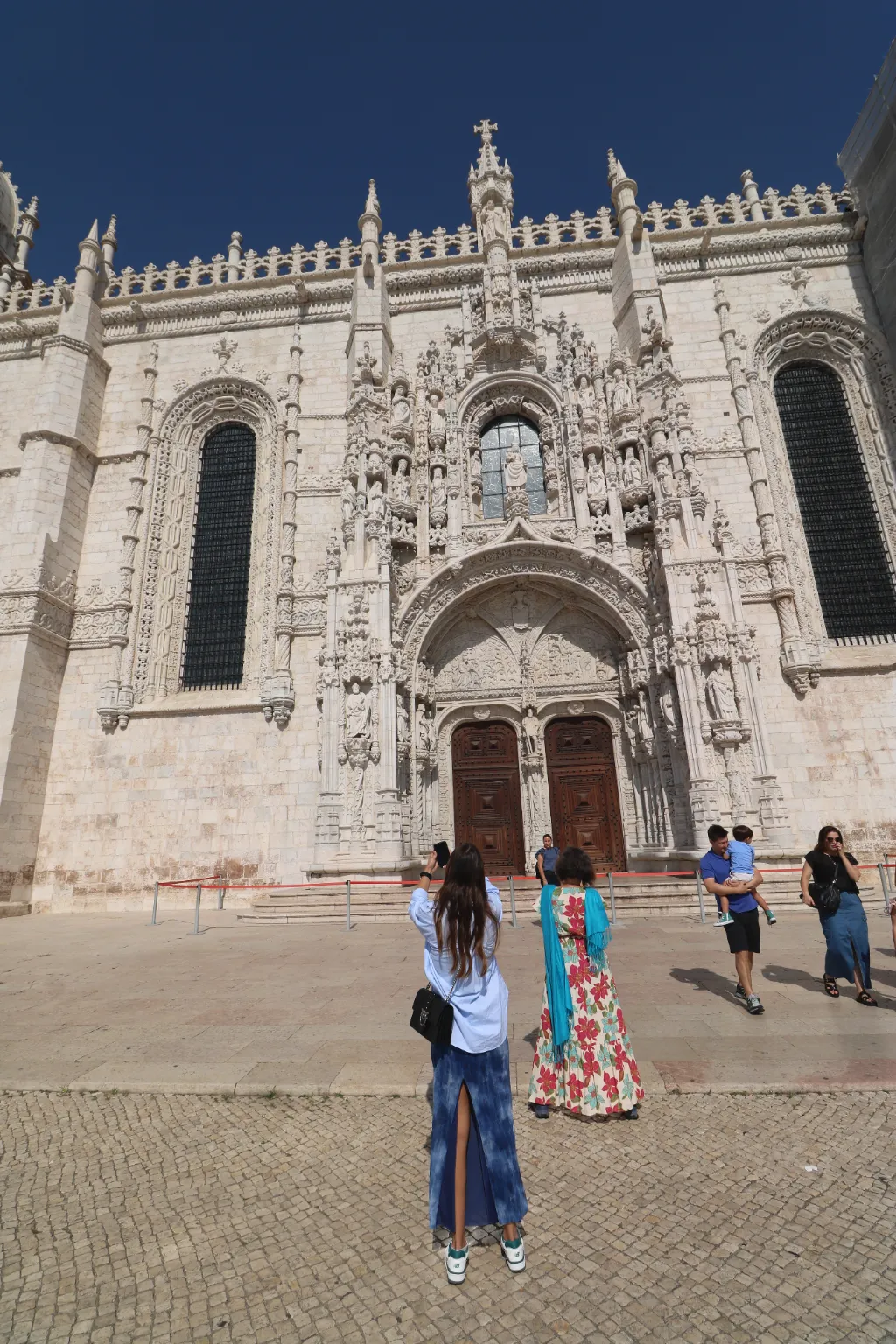
There is a particularly pleasing sense of scale in this photograph. Two tall, dark, grilled windows flank the astonishingly elaborate doorway, while the deep blue Portuguese sky provides a nearly perfect background for the delicate stone pinnacles and the ornamental parapet. The two heavy wooden doors look almost modest beneath the mass of sculpture above them. In the foreground, a woman in a light blue shirt and long denim skirt raises her phone towards the facade. Another visitor wears a floral dress and a turquoise shawl, and a man carrying a small child walks across the sunlit square. The curved patterns of the Portuguese pavement complete the scene. Five centuries of architectural history meet a perfectly ordinary afternoon of sightseeing.
The monastery was commissioned by King Manuel I at the beginning of the sixteenth century, when Portugal was establishing maritime trade routes across the world. The wealth generated by this expansion helped fund an immense building project in Belém. The site became a religious institution and a royal monument, expressing the ambitions of a kingdom whose ships were reaching increasingly distant ports. Together with the nearby Belém Tower, the monastery was inscribed on UNESCO's World Heritage List in 1983.
Manueline architecture, named after the king, developed from late Gothic traditions with distinctive Portuguese ornamentation and emerging Renaissance influences. Its most recognizable features include twisted stone mouldings, intricate foliage, heraldic emblems and forms suggestive of maritime equipment. Religious imagery and the symbolism of royal power are often interwoven. The south portal, constructed by João de Castilho and his team between 1516 and 1518, following a design by Diogo de Boitaca, is an especially theatrical example. Our Lady of Belém stands above the entrance with the Christ Child, surrounded by ranks of sculpted figures. Look at the small canopies over the statues: each is almost a miniature building in its own right.
An interesting detail is that this lavish composition occupies the side of the church facing the open space towards the Tagus. The western entrance has its own sculptural program. Once inside, the character of the architecture changes considerably. Slender carved columns rise into an elaborate network of stone vaults, and the spacious interior contains the tombs of Vasco da Gama and the poet Luís de Camões. The cloister, visited separately, provides a quieter setting in which to appreciate the craftsmanship at close quarters.
Allow yourself some time outside before joining a queue. On clear days, direct sunlight reveals the texture of the limestone, and a slightly oblique view helps the relief carvings stand out. A telephoto lens or a phone with a good optical zoom is useful here, particularly for studying the figures high above the entrance. Include a few visitors in a wider composition. Without them it is surprisingly difficult to appreciate just how monumental the portal really is.
Belém deserves more than a quick photograph between scheduled attractions. From the monastery, it is an easy walk towards the riverfront, and there is always the prospect of a coffee and a warm pastel de nata nearby. For practical advice on visiting the church and cloister, see our guide to visiting Jerónimos Monastery, and TravelMktg.com’s guide to beating the queue.