Pena Palace Cloister Preserves the Monastery Inside the Royal Fantasy
Pena Palace in Sintra is usually photographed from outside, where its red and yellow walls rise above the wooded hills. Step into the small cloister and the scale changes. The walls close around a courtyard, the galleries bring people within speaking distance of one another, and the palace begins to reveal the monastery that stood here before the royal residence took shape. There is plenty of colour here too, though it works differently. You find yourself looking at individual tiles rather than trying to fit an entire skyline into a photograph.
In this view, a red clock tower rises against a clear blue sky, its pale stone edges picking out the little turrets and battlements. Below it, two levels of arcades wrap around the courtyard. Dense bands of blue, green and ochre tilework run between weathered columns, while the blue-and-white paving spreads across the foreground in squares and diagonal lines. A large shell-shaped stone planter holds a fern at the centre, surrounded by smaller pots. Visitors lean into the shade of the upper gallery. The sunlight catches the right-hand pillars so strongly that the recesses behind them seem almost like another room. It is an enclosed space with a remarkable amount happening in it.
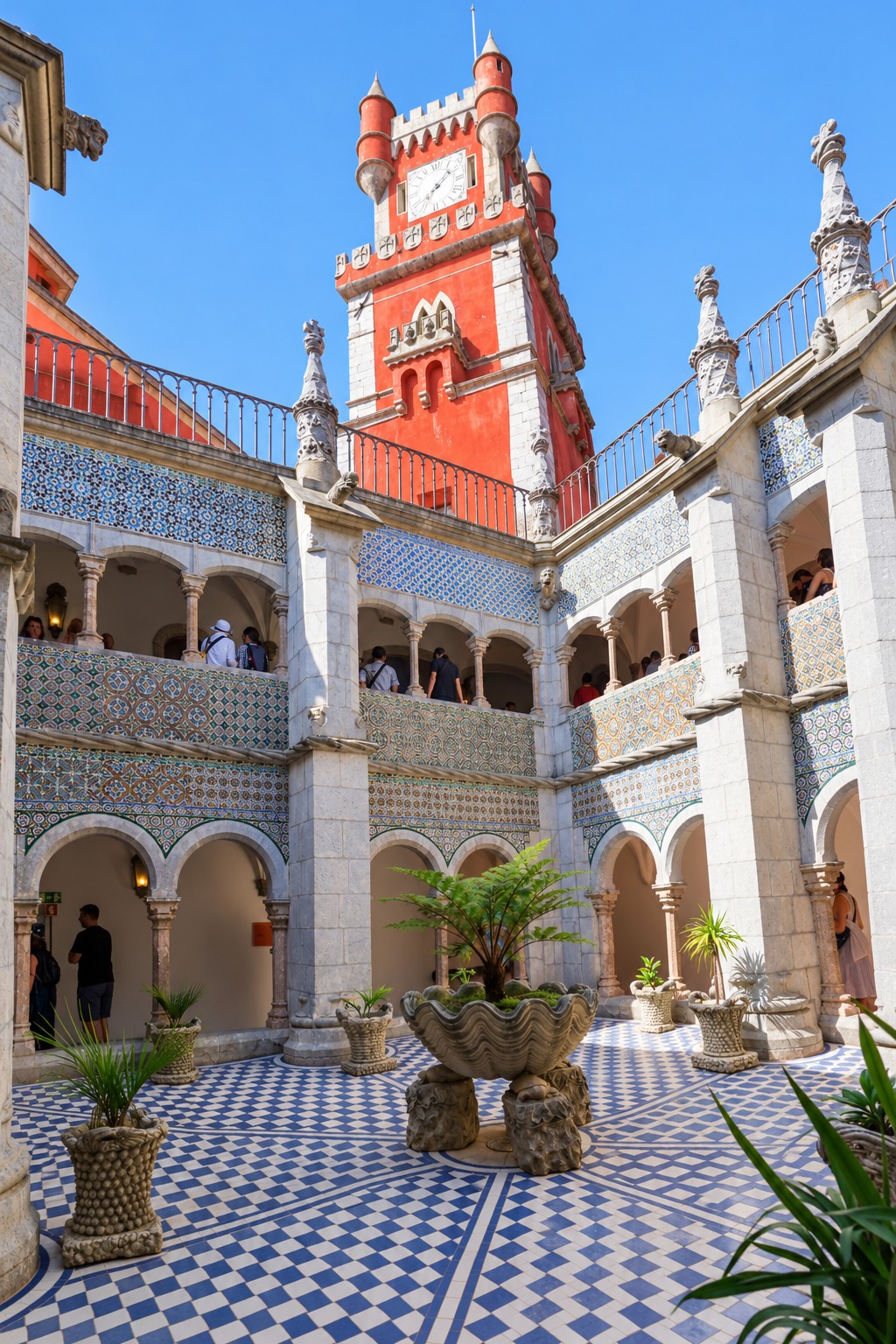
Image credit: VirtualTravelGuide.com.
The cloister belongs to the early sixteenth-century religious complex that survives within Pena. Construction of the monastery was ordered by Manuel I in 1503, and the cloister dates to around 1511. Its compact proportions reflect the small community of monks who lived here. When Ferdinand II developed Pena as a royal residence in the nineteenth century, the earlier building became part of a much larger architectural composition. The church and cloister remained, carrying an older rhythm into the new palace. That survival gives this courtyard its particular interest: the royal project grew around rooms already shaped by another way of life.
Look closely at the walls and the decoration becomes more varied than the first impression of blue-and-white suggests. The geometric tile panels include several patterns, with warm colours breaking up the cooler areas. These Hispano-Mudéjar tiles connect the courtyard to the ceramic traditions of the Iberian Peninsula. Their small repeated forms sit against much larger architectural divisions, so your eye moves between a single motif and the whole wall. The lower arches are rounded; those above are flatter. From the courtyard floor, the difference is easy to miss until you follow one gallery around the corner.
For photography, this is a place to give the paving some room. The floor makes the depth of the courtyard readable, and the central planter provides a useful point around which the surrounding lines turn. A vertical composition can carry the eye from those patterns up to the clock tower. Bright sun makes exposure awkward, admittedly. Protect detail in the pale columns and allow the shaded galleries to retain some darkness; flattening every shadow would lose the sense of shelter that makes the arcades appealing. Take the wider view, then look for a smaller frame where tile, stone and a single arch meet.
If the cloister is a priority, plan for the palace interior route and check the access included in your chosen ticket. As checked in October 2026, the booked time refers to entry at the palace, and the operator advises allowing about 30 minutes between the park gate and the palace entrance. Arriving at the park at your palace time leaves that uphill journey still ahead of you. Give yourself breathing space, then follow the permitted route without blocking the narrow galleries. Our Pena Palace ticket guide covers the broader visit. Here, the reward is in spending a little attention on the courtyard itself, where the old monastery is still legible beneath the red tower.