Palermo, Sicily's Most Cinematic and Photogenic City
Palermo is a city that seems almost designed for the camera. Its monumental architecture, theatrical public squares, sunlit stone façades, crowded markets and narrow streets create an extraordinary visual experience. Yet what makes the Sicilian capital so photogenic is not simply the beauty of its buildings. It is the collision of architectural styles, centuries of history, Mediterranean light and everyday urban life. Palermo looks cinematic because it rarely looks staged.
The photograph of Palermo Cathedral captures this quality particularly well. A marble statue of a bearded saint dominates the foreground, his flowing robes and expressive gestures standing out against the cathedral's warm limestone walls. Behind him, a monumental clock tower rises with its Roman-numeral dial, while a great copper-green dome fills the left side of the composition. Above everything stretches a remarkably deep blue November sky. The contrast between the pale sculpture, golden architecture and saturated blue creates an almost painterly image, reminiscent of a historical film set.
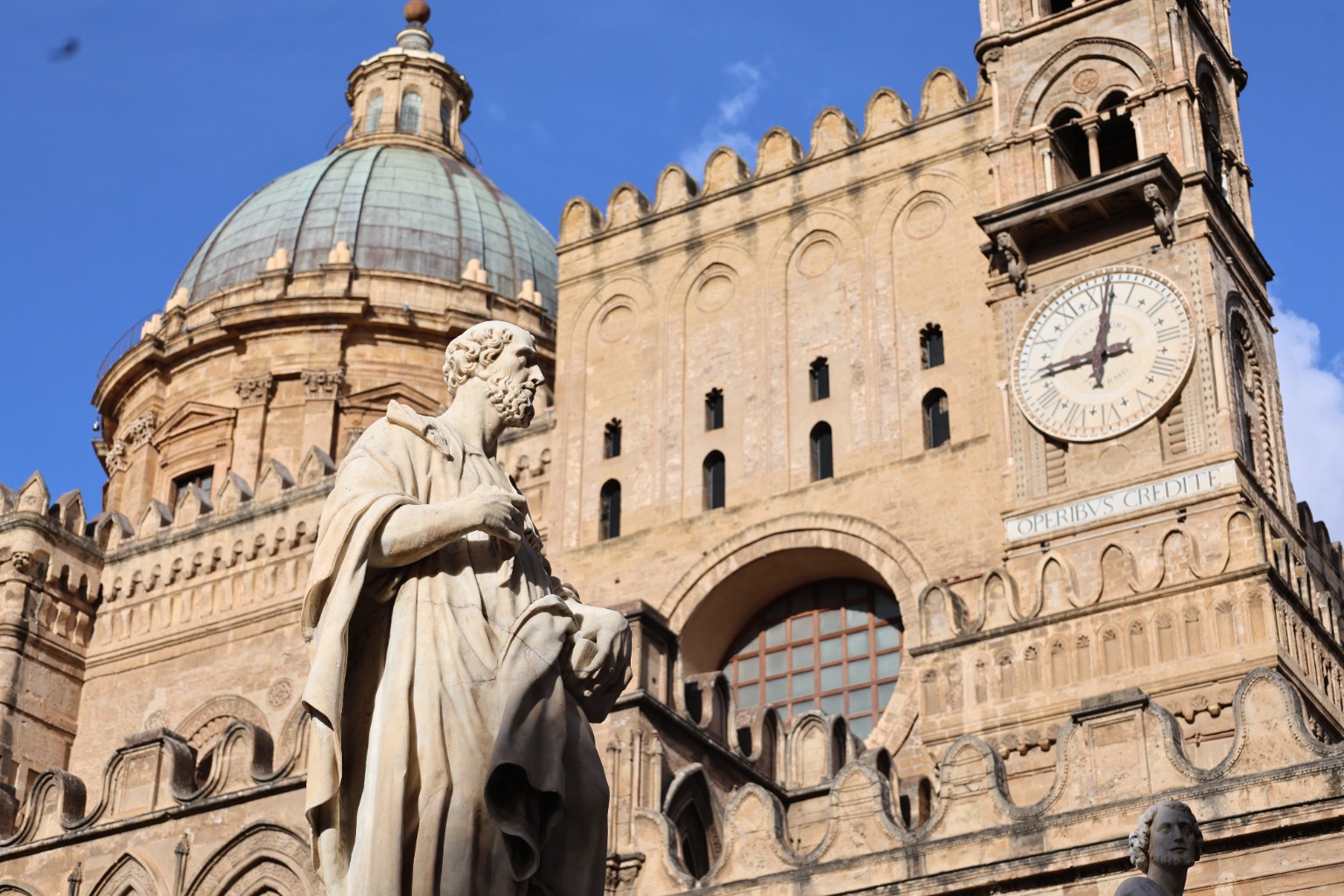
Photograph hosted by Pxef.com.
But Palermo is not a film set. It is a living city, sometimes chaotic, frequently imperfect, and all the more interesting for it.
Palermo's streets have a particular talent for producing scenes within scenes. A scooter passes through an ornate gateway; a market vendor stands under a striped awning; a pedestrian appears at the far end of an alley, framed by balconies and laundry. Even a short walk can deliver the kind of layered composition that photographers elsewhere might spend hours trying to arrange.
The city's architecture supplies a remarkable variety of backdrops. Palermo Cathedral combines Norman, Gothic, Renaissance and Baroque elements in a single monumental complex. Its towers, domes and sculptural details reward both wide architectural photographs and tighter studies of texture and geometry. Nearby, the Quattro Canti intersection offers a different kind of spectacle: four richly decorated façades turn an ordinary crossing into an outdoor theater. Piazza Pretoria, with its fountain and sculpted figures, invites dramatic compositions in changing light.
Then there are the Arab-Norman monuments, among the city's most distinctive sights. The Norman Palace and Palatine Chapel reveal Palermo's remarkable cultural inheritance, while San Giovanni degli Eremiti, with its red domes, looks unlike the churches visitors expect to find elsewhere in Italy. The coexistence of Islamic, Byzantine, Norman and later European influences gives the city an architectural vocabulary of its own.
For street photography, the historic markets are essential. Ballarò, Capo and Vucciria have very different rhythms, but each offers the color, movement and human detail that make Palermo so visually memorable. Crates of citrus, seafood counters, handwritten signs, weathered shopfronts and animated conversations are all part of the picture. These are working neighborhoods, not photographic attractions, so a little patience and respect go a long way.
Light is perhaps Palermo's greatest collaborator. On a clear day, the sun can carve strong shadows into the limestone façades and make the sky appear almost impossibly blue. Early morning is excellent for quieter streets and gentle side lighting; late afternoon warms the stone and emphasizes its texture. At midday, instead of fighting the contrast, photographers can use archways, arcades and narrow streets to turn hard shadows into graphic shapes.
November has its own advantages. The city is less crowded than during the summer peak, and a low autumn sun can create beautiful directional light for much of the day. Blue skies are still possible, as this cathedral photograph demonstrates, but passing clouds and occasional rain can make the city feel even more atmospheric. Wet paving stones, reflected lights and dramatic skies are opportunities rather than disappointments.
Palermo also works beautifully in monochrome. Remove the colors and the eye begins to notice the expressive faces, intricate masonry, deep shadows, worn doors and theatrical silhouettes. A black-and-white series made around the markets and historic center could feel like stills from an Italian neorealist film. Color, meanwhile, captures the warmth and exuberance of the city: ochre stone, faded painted walls, market produce, blue sky and the occasional flash of brilliant red.
The best way to photograph Palermo is on foot, without an excessively rigid itinerary. Start near the cathedral, wander toward the Quattro Canti and Piazza Pretoria, and then allow the streets to pull you toward the markets. Look up at balconies, look through open gateways, and occasionally turn around: the most interesting photograph may be behind you. A wide-angle lens is useful for architecture and cramped streets, while a moderate telephoto helps isolate sculptural details and compress the busy layers of urban life.
What distinguishes Palermo from more polished destinations is its refusal to become merely picturesque. Beauty sits beside decay, grandeur beside ordinary commerce, silence beside noise. The city has texture, contradictions and personality. For a traveler with a camera, that is an extraordinary gift.
Palermo does not need perfect weather, empty streets or carefully arranged viewpoints to look cinematic. Its drama is already there, written into the buildings and played out every day in its squares and markets. The photographer's job is simply to notice it.