Taormina, Sicily: A Fountain, a Crowd and the Art of Enjoying a Piazza
Taormina has a remarkable talent for making an ordinary summer afternoon feel like a theatrical performance. There is no need for a festival, a parade or any particular occasion. A fountain, a handful of historic buildings, some Sicilian sunshine and a constantly changing cast of visitors are quite enough. In Piazza Duomo, the small square surrounding Taormina's famous Baroque fountain, the performance seems to organize itself.
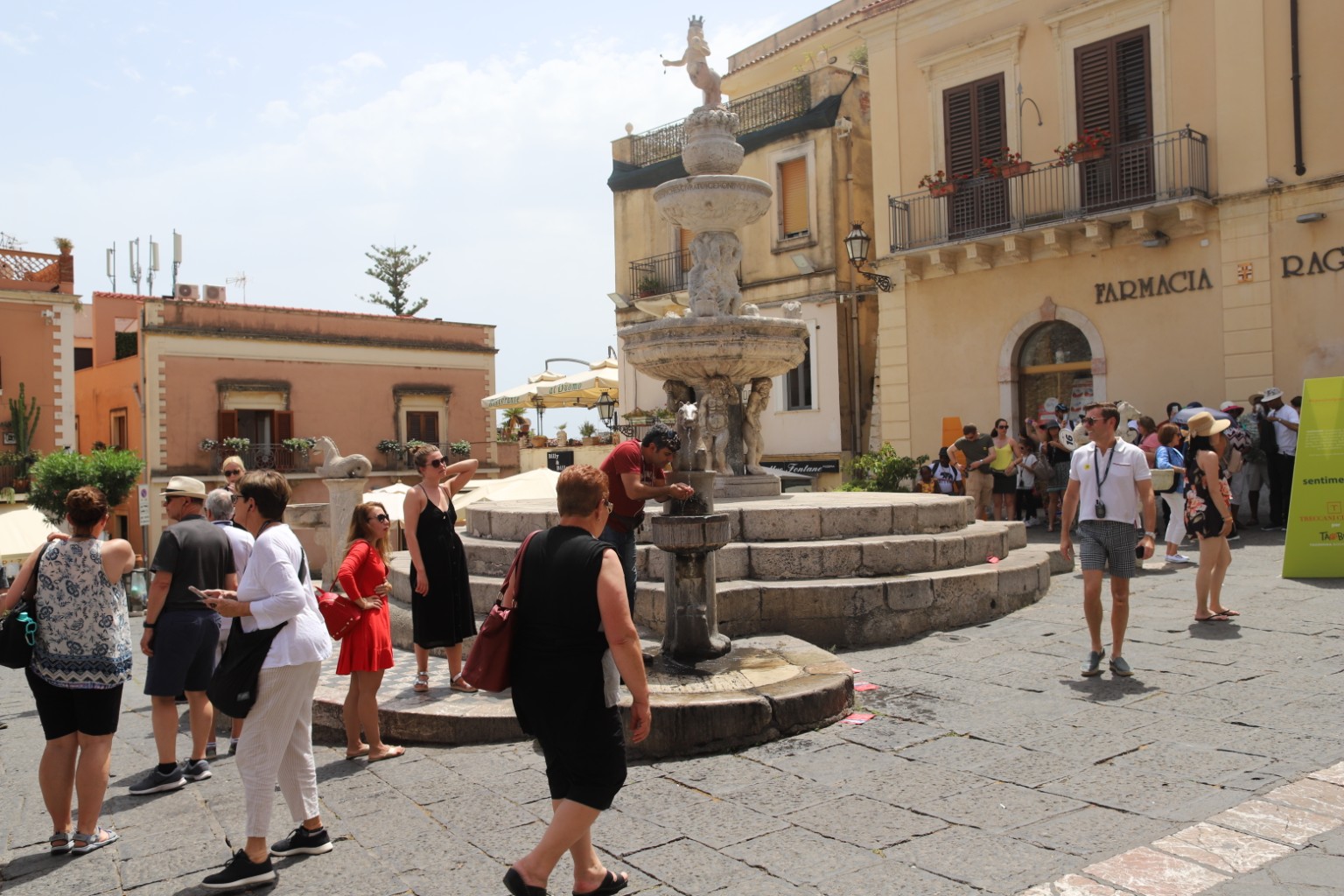
Photo credit: MediaInstances.com
At the center stands the Fontana di Piazza Duomo, often called the Four Fountains, crowned by a curious creature that is part of Taormina's civic identity. The crowned centaur-like figure, with a female torso and animal body, is an unusual emblem for a town whose history stretches from ancient Greek settlement through Roman, Byzantine, Arab and Norman rule. Below it, sculpted figures support the fountain's ornamental basins, while the stone steps around the monument provide an informal meeting place for visitors from everywhere.
The photograph captures the square at its most wonderfully untidy. A man in a red shirt bends over the lower fountain, apparently looking for some relief from the heat. A woman in a black dress stands nearby with one hand behind her head, while another in bright red provides an unexpected splash of color against the pale stone. Tourists in shorts, summer hats and sunglasses drift through the scene. On the right, a group gathers outside the pharmacy, beneath balconies with dark wooden shutters and flower boxes. Behind the fountain, faded ochre walls and a pink building give the square the slightly worn elegance that makes Sicilian towns so appealing.
This is not the empty, meticulously composed Taormina of promotional brochures. It is much better than that. The people are part of the architecture, at least for the few seconds captured by the camera. The fountain has stood through generations of changing fashions, languages and political regimes, and today it finds itself surrounded by smartphones, tourist groups and people wondering where to have lunch. Somehow, none of this diminishes its dignity.
There is a temptation when visiting Taormina to concentrate entirely on its spectacular Greek Theatre, the views toward Mount Etna and the Ionian Sea, or the fashionable boutiques along Corso Umberto. Those attractions certainly deserve their reputation. Yet the smaller squares reveal something equally interesting: how a historic town continues to function as a living place even while accommodating an enormous tourism industry.
Piazza Duomo is especially good at this balancing act. Its buildings are grand enough to remind visitors of Sicily's architectural inheritance but modest enough in scale to remain approachable. The cathedral nearby, with its fortress-like medieval character, provides a contrast to the fountain's elaborate ornamentation. The surrounding façades are not uniformly restored, and that is part of their charm. Weathered plaster, mismatched shutters, old stone and modern commercial signs coexist without much concern for visual consistency.
And then there is the light. Sicilian midday sunshine is rarely gentle, particularly in summer. It creates hard shadows, bleaches the paving stones and encourages everyone to seek shade or water. For photographers, it is not necessarily the easiest light to manage, but it tells the truth about the place. Taormina in summer is hot, busy, bright and occasionally exhausting. Pretending otherwise would mean missing much of its character.
What I particularly like about this scene is the absence of a single dominant human subject. The eye moves around the square, discovering little stories. The photographer is not directing the action; the town is doing that. A few seconds later, every human arrangement would be different, while the fountain and buildings would remain exactly where they were.
Perhaps that is the real pleasure of Taormina. Its famous monuments are worth visiting, but its everyday theater is worth watching. Find a place to sit, order something cold and allow the square to entertain you. Sicily has been practicing this particular art for centuries.