Isola Bella, Taormina’s Island Between the Mountains and the Ionian Sea
From the hills of Taormina, Isola Bella looks almost too small to have a history of its own. A rocky island rises out of the Ionian Sea below the town, joined to the Sicilian mainland by a slender strip of pebbles. Houses are tucked into the vegetation, and the water around the island changes colour with its depth. It is one of those places where the journey from the town to the sea is as much a part of the experience as the beach itself. Taormina is a destination built on different levels, and the view down to Isola Bella makes that especially clear.
In this photograph, the sky is a pale, hazy grey-blue, and the sea has none of the exaggerated turquoise of a Mediterranean tourism poster. The island occupies the middle distance, with pale limestone boulders at its base, dark upright trees and a small terracotta-roofed building near the summit. Tiny figures are scattered along the narrow crossing, while rows of blue and green beach umbrellas occupy the curving shore. A few palms rise above the beach facilities. On the right, another steep headland stretches into the sea. Closer to the camera are railway tracks, tiled rooftops, satellite dishes and splashes of pink bougainvillea. These everyday details give the landscape a sense of scale and remind you that this extraordinary little island sits beside a working, inhabited coastline.
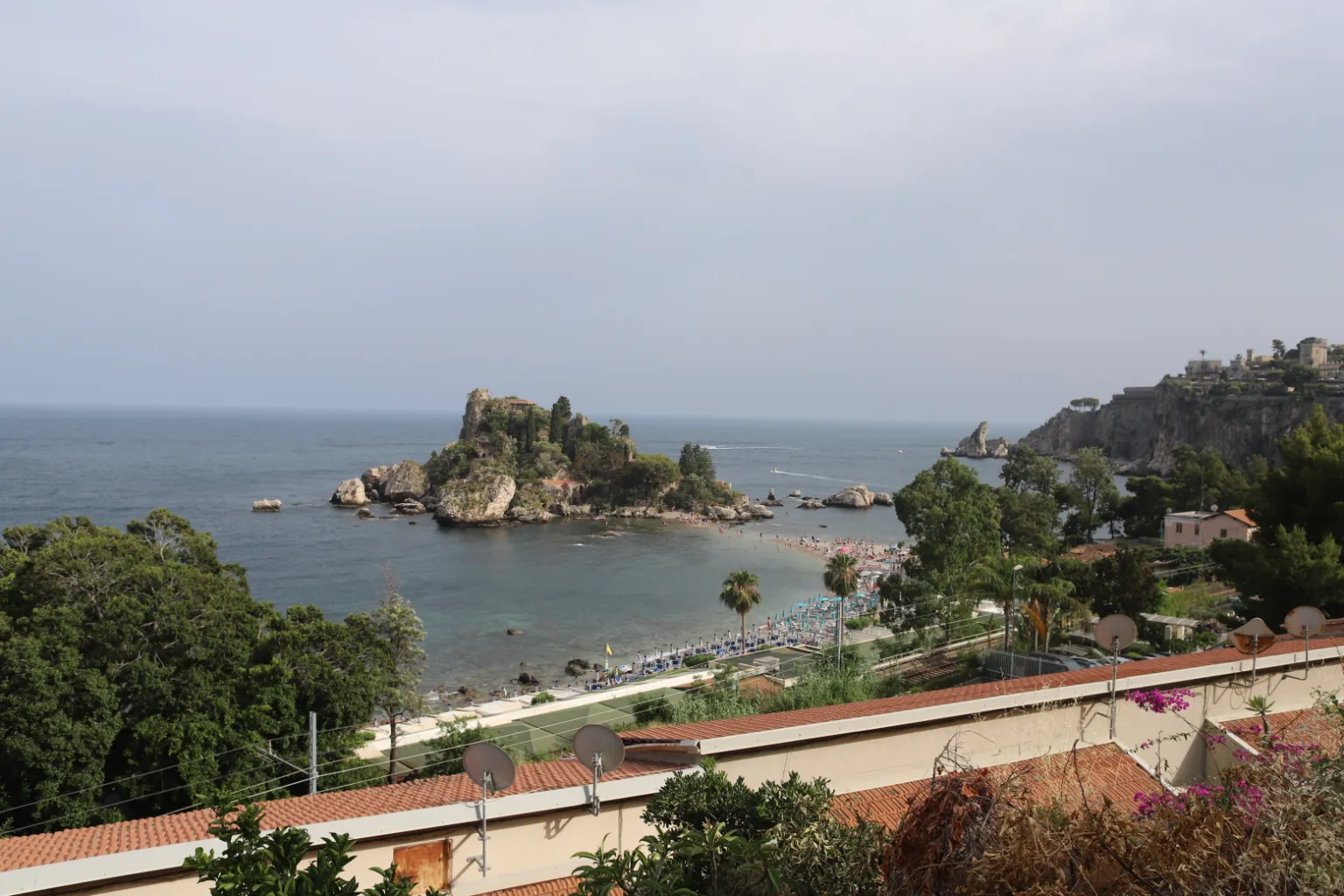
The island owes part of its character to Florence Trevelyan, an Englishwoman who settled in Taormina and acquired Isola Bella in 1890. She developed a garden on the rocky ground, bringing exotic plants into an existing Mediterranean landscape. After the Second World War, the Bosurgi family added a residence arranged in separate structures among the trees and rocks. This unusual approach to building helps explain why the island still looks so green from the mainland, despite its history as a private retreat. It became a nature reserve in 1998. The bay has a much older human history, too: underwater archaeological discoveries point to its use as a landing place in antiquity.
Visitors staying in central Taormina should resist the temptation to treat Isola Bella as a quick detour. The town stands well above the coastline. The cable car connecting Taormina with Mazzarò offers a convenient way down when it is operating, followed by a short walk to the beach access. There are steps between the road and the shore, so consider the climb back before setting out in the midday heat. The beach itself is pebbly, and a pair of water shoes makes a surprisingly large difference. The narrow crossing to the island changes with sea conditions; you may have to wade through shallow water. Access to the protected island and its buildings is managed separately from access to the beach, so check the reserve's opening arrangements before visiting.
For a beach day, arrive early in warm weather, especially if you prefer a quiet swim to the bustle of a busy lido. The water around the rocks is appealing for snorkelling when the sea is calm, but respect the reserve's boundaries and leave its stones, plants and marine life undisturbed. For photography, the elevated viewpoint has an advantage that disappears at beach level: you can see how the little island fits into the shape of the entire bay. A photograph from the shore offers a different experience, emphasizing the texture of the rocks and the changing width of the crossing. Even on a hazy day, there is plenty to work with.
Save some energy for the return to Taormina, where the old town feels almost like another destination after a few hours beside the water. A swim below the cliffs and an evening walk along Corso Umberto make a particularly rewarding combination. For more practical information about the coast, see TravelMktg.com's guide to the beaches of Taormina and our feature on Taormina's Piazza Duomo.