Wrocław Cathedral, Gothic Towers and the Resilience of a Polish City
Wrocław Cathedral does not reveal itself gently. Approaching through the streets of Ostrów Tumski, the old ecclesiastical heart of the Polish city, you suddenly find yourself looking up at two enormous brick towers. Their stone details seem almost impossibly intricate from street level, and the surrounding houses make the cathedral appear even taller. This is the Cathedral of St. John the Baptist, one of Wrocław's defining landmarks and a remarkable survivor of Central Europe's turbulent history.
Photograph: Pxef.com.
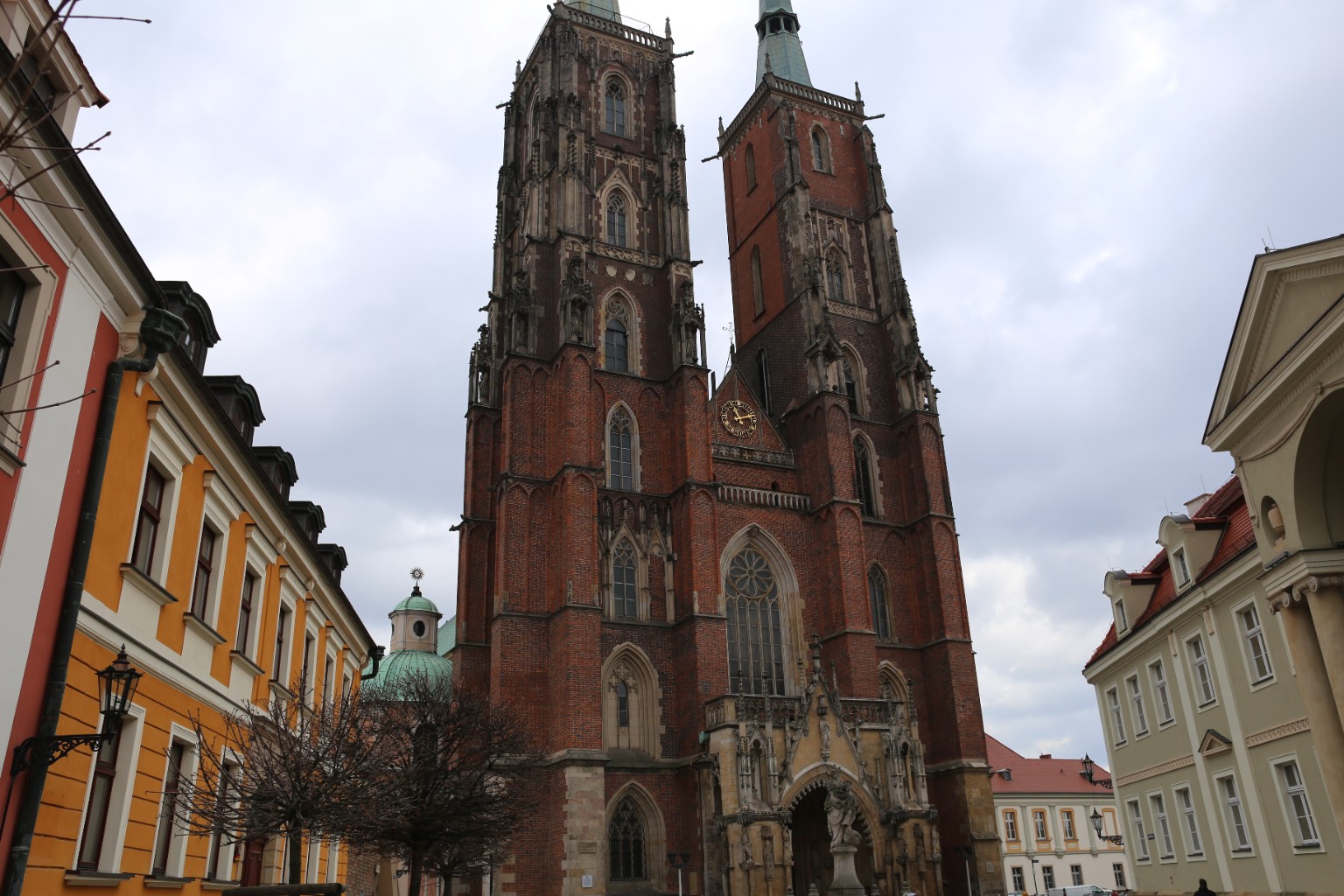
The view from the cathedral square is especially striking because it places monumental Gothic architecture within an intimate urban setting. On one side, a row of ochre and cream buildings leads the eye toward the church; on the other, pale façades with red-tiled roofs close in around the square. Leafless trees reveal the lower stonework, while a copper-green dome peeks out behind the buildings. Above everything rise the cathedral's dark-red brick towers, patterned with pointed openings, weathered stone tracery and sculpted pinnacles.
Between the towers is a small golden clock, almost lost amid the vertical lines. Below it, the great pointed window and richly decorated entrance draw the eye down to human scale. The elaborate portal and its statuary make this much more than an impressive silhouette: it is a building that rewards looking closely.
The history of this site stretches back to the establishment of the Wrocław bishopric around the year 1000. Several churches preceded the present cathedral. Much of the Gothic building visible today took shape during the thirteenth and fourteenth centuries, when Wrocław was an important commercial and religious center in Silesia. Its architecture reflects the brick-building traditions of the region, enriched with carefully worked stone around windows, portals and buttresses.
For centuries the city was known by different names and governed by different powers. Its German name, Breslau, is inseparable from the cathedral's twentieth-century story. During the final months of World War II, the city endured a devastating siege. The cathedral was severely damaged in 1945, with large parts of its roof, interior and structure destroyed. What visitors see today is therefore both medieval heritage and a major achievement of postwar restoration.
Rebuilding was not a single project completed overnight. It required years of painstaking work, with the restoration of the towers' distinctive spires coming much later, in the 1990s. This history changes how one reads the façade. The building's apparent continuity conceals a remarkable amount of loss, craftsmanship and determination.
Inside, visitors can appreciate the scale of the Gothic nave and the cathedral's chapels, monuments and religious artworks. The building also contains elements from different periods, reflecting centuries of changing taste and patronage. If access is available during your visit, the tower viewpoint offers an opportunity to see Wrocław from above, including the river, bridges and dense roofs of the historic center. Opening arrangements may vary around services and special events.
Yet the cathedral is only one reason to explore Ostrów Tumski. Despite the name, meaning Cathedral Island, the district is no longer an island in the strict geographical sense. It remains one of Wrocław's most atmospheric places, especially in the late afternoon when the streets become quieter. The neighborhood is known for its historic churches, cobblestone streets, river crossings and traditional gas lamps, some of which are still lit by a lamplighter.
A rewarding walk begins near the Tumski Bridge and continues toward the cathedral through the old ecclesiastical streets. Rather than rushing straight to the entrance, pause in the square and move around a little. The proportions of the towers change dramatically as the nearby façades frame them from different angles. The approach shown in this photograph is particularly effective because the buildings on both sides create a natural architectural corridor.
Photography here benefits from patience. A wide-angle lens can capture the full height of the towers from the confined square, although tilting the camera upward will exaggerate perspective. A more moderate focal length emphasizes the brickwork and stone details. Overcast skies, like those in the photograph, can be useful: they soften harsh shadows and make the deep reds of the masonry and the pastel colors of neighboring buildings stand out.
Plan enough time to walk beyond the cathedral itself. Wrocław is a city of islands and bridges, and the transition from the quiet religious quarter to the busy market square is part of its appeal. The cathedral gives visitors a powerful introduction to the city's layered identity: medieval, Silesian, German, Polish and unmistakably its own.
The most memorable thing about Wrocław Cathedral may ultimately be this contrast. From a distance it seems like an ancient landmark that has always stood exactly as it does today. Up close, it tells a more complicated story of repeated construction, destruction and recovery. That is precisely what makes a visit worthwhile.